 www.LED
  .com
.com |
 |
 |
 |
 |
 |
 |
 |
 |
 |
 |
 |
 |
 |
 |
 |
 |
 |
 |
 |
Light color (nm)
Our German sites are much more detailed then our English sites. So please switch in our Germen sites and use the language translater (top right) with 60 languages.

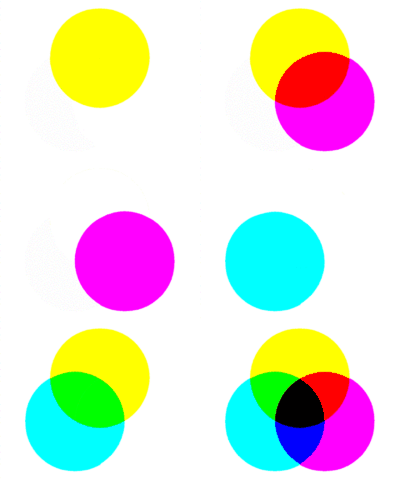
The wavelength describes the distance between two sequential points of a wave, swinging in phases. This distance is measured in Nm (nanometers). The visible colors of the rainbow decrease in the wavelength from red to blue. The visible range lies between scarcely 370 Nm (violet) and 750 Nm (red).
Light, which consists with full intensity and same portions of all 3 wavelengths, as red, green and blue, we feel as WHITE.
(look at the left animation)
If light consists of only 2 different wavelengths, we see with a combination from short and medium-waves the color cyan, with medium and long-waves the color yellow and a combination from long and short-waves we see the color magenta.
(look at the right animation)
If no electromagnetic waves of the chromatic spectrum meet into our eye, then the color preception is
BLACK.
Diese schöne Animation wurde von Prof. Michael Bach erstellt. Wir danken herzlich für die Nutzung!
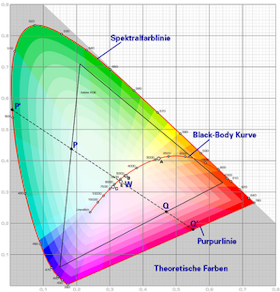 In order to exactly define each color by coordinates, we let assume the imaginary basic colors [ X ], [ Y ] and [ Z ]. They form the triangle corner points of the entire color area. The standard color chart represents, how largely the relative portions of x of the basic color [ X ] and y of [ Y ], to each other color is. The units are in such a way selected that the white point lies with x, y, z = 1/3. The two numbers of x and y shows the color value of the color. (the standard color proportional value of z can be calculated, because it is x+y+z=1). The brightness is indicate by the luminous intensity.
This very nice graphic was made by Mr.Torge Anders alias:DiplomBastler for http://de.wikipedia.org and under GNU-Lizenz for free publishing. We say thankyou for using. |
Led controls ensures that the correct value of colors are set and so we can create all effects we want.
The CIE standard specification since 1931) is practically the usually-used perception-referred color description system. The horseshoes-shaped range of possible colors is laid on with the CIE standard specification on a coordinate system. The x and y-position of any color can be read off directly.
All possible colors are included by the spectral color line (spectrally pure colors) as well as the purple boundary (straight line from 400nm to 700nm).
CRI INDEX
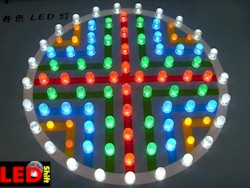
The Color Rendering index (CRI) is a value for a source of light, which indicates the color reproduction of lighted objects. The CRI is easily avowed: The CRI value can lie only between 0 and 100. Everything over 95 is considered as super, everything under 70 as bad. That means, if the CRI- INDEX is higher, more pleasantly colors the lighted object shows.
Sunlight has e.g. the CRI value of logic 100. "warm" white LEDS with a color temperature of 3000K possess a CRI of approx. 80.
| AGB Ledshift | LED Function | LED Producer | LED Distributor | LED Events | LED Company Entry | LEDS | Sitemap | Contact | |
 |
 |
© Markus Kottas, Heldenberg Ltd.2018