 www.LED
  .com
.com |
 |
 |
 |
 |
 |
 |
 |
 |
 |
 |
 |
 |
 |
 |
 |
 |
 |
 |
 |
Luminous flux (lm, Lumen)
PLEASE NOTE!!!:
Our German sites are much more detailed then our English sites. So please switch in our Germen sites and use the language translater (top right) with 60 languages.
The light-current is the unit of power in the photometric system.
If e.g. an isotropically radiating source of light shines with 1 candela , i.e., sends 1 lm per 1 SR, you get the luminous flux by summation of luminous intensity over the entire area, which surrounds the source of light:
1x (lm: SR) x4x3,14xsr= 12.566 lm. The density of light, measured in lux, can be converted into light-current and luminous intensity.
Lumen = lux x m ²
Brightness is not equal to brightness:
Our human color perception is not easy to seize. Here a simply demonstration: One takes a green LED and a red LED, which deliver both the same radiating power. With a measuring instrument one would measure the same radiation with both light emitting diodes. Instrumentation the two LEDS would be equivalent. Humans see however differently. Our eye appears the green LED much brighter than the red LED. We determine, the relative eye sensitive depend on the wavelength of the light.
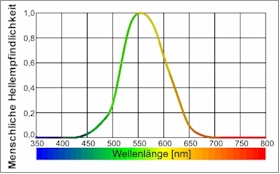
This dependence of the light sensitivity, of the wavelength is held in so-called light response curves of the CIE (Commission international de l'Eclairage) for a standard observer.
There are several of such curves for different lighting conditions (twilight, midday sun, etc.). The accompanying illustration shows the light response curve for daylight.
We see, that the maximum is about 550 nm, therefore with green light. With red light the sensitivity is more than the factor 10! smaller.
Therefore we take the red LED (wavelength approx.. 650 Nm) much darker truely than the green (wavelength approx.. 550 Nm), although they deliver physically the same radiating power.
to do with our light-current (lumen)?
Because the light-current is a physiological size!
But what is a physiological size?
The light sensitivity diagram is based on average observations of hundreds of test persons and no machines. Therefore the light-current and the unit lumen are an empirical, physiological size.
And now the crucial point comes:
The luminous flux of a colored LED is the product = of its theoretically maximally luminous efficiency (the maximum value lies with a wavelength 555nm and is named km). Km has a value of 683 lumen/Watts), it is a fixer value,
multiplied by the spectral light sensitivity degree associated for the respective wavelength
(Green = 555nm = 1, red = 670nm = 0,1) and the radiating power in Watts.
Example with 1 Watt LED:
Red LED 670nm = 683(lm/W) x 0,1 (Km) x 1 (W) = 68,3 lm
Green LED 555nm = 683 (lm/W) x 1 (Km) x 1 (W) = 683 lm
With white LEDS the light-current strength (lm) of the individual wavelengths is added.
And now still some remarks to the term lumen/Watt (lm/W), which is ever more frequently used.
Watt is physical dimension and means work per time. A power source supplies a certain "energy flow" and carries thereby a certain work out in a certain time. So similarly one can imagine the term Luminous flux: A certain quantity light is radiated in a certain time. While Watt is however a physical unit, lumen is a physiological size. Here we see also why a bulb is such a bad source of light. A 100W bulb has a luminous efficiency from only 15 lm/W. Thus with a capacity of 100W we receive only 1500 lumens. The remainder is lost in the form of heat and not visible radiation!
| Light source | Lumen/Watt(average) |
| Bulb (100 W) | 15 |
| Halogen bulb (50 W) | 20 |
| Halogen bulb (12 V) (55 W) | 28 |
| Energysavinglamp | 60 |
| Xenon-gasdischargelamp | 47 |
| Mercury-Xenon-arc lamp | 55 |
| Natriumlamp | 130 |
| Fluorescent tube | 75 |
| Halogenmetallamp | 88 |
| mercury-arc lamp | 60 |
| Xenon-gas steam lamp (PKW) | 95 |
| Sulfur steam lamp | 95 |
| Natrium steam lamp | 200 |
| Coldkathode (CCFL) | 55 |
| AGB Ledshift | LED Function | LED Producer | LED Distributor | LED Events | LED Company Entry | LEDS | Sitemap | Contact | |
 |
 |
| © Markus Kottas, Heldenberg Ltd.2018 |