 www.LED
  .com
.com |
 |
 |
 |
 |
 |
 |
 |
 |
 |
 |
 |
 |
 |
 |
 |
 |
 |
 |
 |
Current
Our German sites are much more detailed then our English sites. So please switch in our Germen sites and use the language translater (top right) with 60 languages.
The radiation of an LED is approx. proportional to the current and depends of the heat dissipation, thus of the temperature what the LED possesses.
We already heard that bulbs converts approx.. 95% of their energy into heat. LEDS have a much higher efficiency but heat is although produced and with strong 1W - 9W LED must be a good heat dissipation present, which is produced by the design.
LEDS are normally operated with 20mA. With strong LED e.g. LED Spot's, is the working current much more highly and can up to 1A. There for the higher temperature. With wired LEDS e.g. the long An and Katoden, take over the cooling.
|
LED color Red Yellow Green Blue White |
Vol. - 20mA 1,9 V 2,1 V 2,2 V 3,4 V 3,5 V |
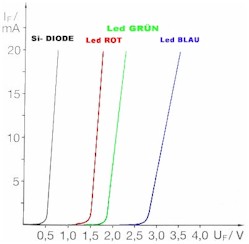 Which current flows with which voltage?
 This question answer the characteristic-line to an LED. The graphic shows the measured characteristic-line of a red, green and blue LED.
One sees that only from a certain minimum voltage or "threshold voltage" in each case a noticeable current flow is starting. With rising voltage the current rises ever more steeply. The measurements were terminated with straight still permitted current by 20 mA but however the further process of the characteristics-line is easily conceivable.
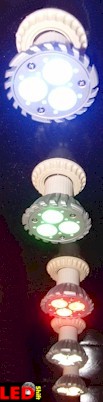 A stronger current causes a higher heat development and the higher temperature produced again more charge carrier. Thus the current rise continues and the semiconductor still more is heating up.
IMPORTANT!
An only slightly higher voltage means to lead a substantially higher current, that very fast can destruct an LED !!!
Therefore also a resistance must lie in each electric circuit with an LED, which limits the current.
Furthermore the developing warmth must be derived.
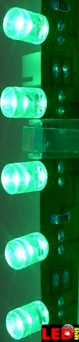 So that actually a river flows from 20 mA, the resistance must be measured accordingly.
R = U/I
During sufficient large battery voltage of e.g. 9 V two or more LED can be switched into row.
The conducting state voltage of the diodes add themselves, so that less voltage lie of the pre-resistor.
Example:
A red and a green LED e.g. have with a diode current of 20 mA and a voltage of 1,9 V + 2.2 V = 4.1 V. At the pre-resistor lies a voltage 9 V - 4.1 V = 4.9 V.
R = 4,9 V / 20 mA R=245 Ohm
We see in the graphic that a e.g. red LED begins to radiate, already with approx. 1,5V to easy and a blue one with approx. 2,7V.
| AGB Ledshift | LED Function | LED Producer | LED Distributor | LED Events | LED Company Entry | LEDS | Sitemap | Contact | |
 |
 |
© Markus Kottas, Heldenberg Ltd.2018