 www.LED
  .com
.com |
 |
 |
 |
 |
 |
 |
 |
 |
 |
 |
 |
 |
 |
 |
 |
 |
 |
 |
 |
Resistor
Pre-resistor
Our German sites are much more detailed then our English sites. So please switch in our Germen sites and use the language translater (top right) with 60 languages.
An LED possesses nearly no internal resistance and if current is put on, there will be a short-circuit because unlimited current would flow through. In order to let an LED shine "correctly" and for long time, one must limit thus current flow with a resistance.
For LEDS the so-called "forward bias" voltage will indicate.
The forward bias voltages is that voltage, which an LED begins to shine and which forms at the LED during radiation. If the voltage at the LED sinks under the forward bias voltages, then no more current flows and... darkly it stays. If the operating voltage is higher and the correct pre-resistor is available then the LED regulates itself on the forward bias voltages and the remaining voltage de-energize at the resistance.
What is RESISTANCE?
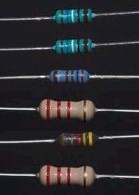 The less free electrons in certain materials, which is present resistance, e.g. the carbon(carbonlayerresittance), are available the less it for a current flow in the electric circuit. If e.g. a broad, slow river is forced to flow by a short tightness then it becomes rapid on this short distance and forms a very fast, strong river.
 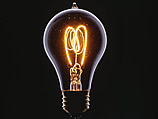 Thus it behaves also in an electric circuit. The resistance R (a tightness), let only few free electrons per time throu and gives thereby to the entire electric circuit the size of the current flow (serial connection). The free electrons can flow in leaders nearly unhampered, but in the resistance they must "rub" itself at the bound electrons. So strongly that the resistance becomes sometimes warm. The bulb e.g. shines, because the thin wire(Wolfram) begins to glow under the influence flowing through the current (friction). Therefore the bulb is so uneconomic and produces much more heat than light.
With a resistance the resistance material is applied on a ceramic stick and covered with a protective layer. The inscription takes place in the form of color rings. Apart from the resistance value also the accuracy class is indicated.
The color code:
The color code is read on the basis of the ring, which is more near to the edge of the resistance.
The first two rings stand for two numbers of the resistance value in ohms.
Resist with high accuracy (metal layer resistors) have mostly 5 or 6 rings.
For 5 rings the first three indicate the values, ring 4 the multiplicator and ring 5 the tolerance.
A sixth ring indicates to the temperature coefficients.
Compare with the table
A resistance with color rings yellow, violet, brown and gold has a value of = 470 Ohm with a tolerance of 5%.
Example:
100 Ohm = brown, black, brown
220 Ohm = red, red, brown
330 Ohm = orange, orange, brown
470 Ohm = yellow, violet, brown
1 Ohm = brown, black, red
| Color |
1.Ring 1.Value |
2.Ring 2.Value |
3.Ring 3.Value |
4.Ring Multiplication |
5.Ring Tolerance |
| non | - | - | - | - | +/- 20% |
| Silver | - | - | - | x 0,01 | +/- 10% |
| Gold | - | - | - | x 0,1 | +/- 5% |
| Black | - | 0 | 0 | x 1,0 | - |
| Brown | 1 | 1 | 1 | x 10 | +/-1% |
| Red | 2 | 2 | 2 | x 100 | +/- 2% |
| Orange | 3 | 3 | 3 | x 1 k | - |
| Yellow | 4 | 4 | 4 | x 10 k | - |
| Green | 5 | 5 | 5 | x 100 k | +/-0,5% |
| Blue | 6 | 6 | 6 | x 1 M | +/-0,25% |
| Violet | 7 | 7 | 7 | x 10 M | +/-0,1% |
| Gray | 8 | 8 | 8 | - | +/-0,05% |
| White | 9 | 9 | 9 | - | - |
| AGB Ledshift | LED Function | LED Producer | LED Distributor | LED Events | LED Company Entry | LEDS | Sitemap | Contact | |
 |
 |
| © Markus Kottas, Heldenberg Ltd.2018 |